Showing posts with label psychology of superheroes. Show all posts
Showing posts with label psychology of superheroes. Show all posts
Monday, April 29, 2013
SXSW: What's the Matter With Batman?
Here's the link to my talk at South by Southwest about What’s the Matter With Batman? An Unauthorized Clinical Look Under the Mask of the Caped Crusader


Wednesday, January 30, 2013
Superheroes To The Rescue--For Real

Flying like Superman in virtual reality can make you more helpful in real life. That's what my colleagues and I found in a recent study. At Stanford's Virtual Human Interaction Lab, Shawnee Baugman, Jeremy Bailenson, and I had participants enter a virtual environment and they were either given the power of flight or rode as passengers in a helicopter. They were then assigned one of two tasks: help find a missing diabetic child or tour a virtual city. Regardless of which task they performed, people who had the power of flight were significantly more likely to help a researcher pick up spilled pens in real life than the helicopter passengers were.
Embodying a superpower in virtual reality may prime players to ‘think like superheroes’ and thus facilitate subsequent helpful behavior in the real world. Alternately, participants who could fly in the game may have felt like more active participants than those who passively sat in the helicopter while performing tasks, and this more active involvement may have induced their subsequent behavior.
And for more about superheroes, take a gander at my new book:
This is a book about seven superhero origins stories, what they reveal about the superheroes' personality, how they reflect the findings of psychological research, why we're interested in their origin stories, and what their stories can teach us about ourselves.
[photo credit: Cody Karutz]
Thursday, January 24, 2013
The Psychology Behind Superhero Origin Stories
From my article in Smithsonian Magazine:
Read more: http://www.smithsonianmag.com/arts-culture/The-Psychology-Behind-Superhero-Origin-Stories-187938991.
“Why is every superhero movie an origin story?” complained Entertainment Weekly film critic Adam Markovitz after seeing a trailer for this summer’s Man of Steel—yet another version of the 75-year-old Superman saga. Perhaps we love origin stories, Markovitz suggested, because they “show the exact moment when a normal guy goes from being Just Like Us to being somehow better, faster, stronger.”
I’m inclined to disagree. As a clinical psychologist who has written books about the psychology of superheroes, I think origin stories show us not how to become super but how to be heroes, choosing altruism over the pursuit of wealth and power. I’ve learned this through hundreds of conversations at comic book conventions, where fans have been remarkably candid about their lives and the inspiration they draw from superhero stories.
Read more: http://www.smithsonianmag.com/arts-culture/The-Psychology-Behind-Superhero-Origin-Stories-187938991.
Wednesday, January 11, 2012
Radio Interview about Real Life Superheroes

Click here to listen to an interview with NPR affiliate WFAE's Mike Collins about real life superheroes.
Tuesday, September 20, 2011
Forging Steel, Part 1: Forging Superheroes Versus Forging Soldiers
 I had the opportunity to speak with some former and current Special Forces soldiers about their training and experience; these are real-life heroes (though they wouldn't necessarily use that term to describe themselves). Their missions and actions rival those of fully human superheroes such as Batman, Black Canary, Batgirl, Oracle, Robin/Nightwing, and Avengers Iron Man, Hawkey, some versions of Black Widow, and Nick Fury, among others. But unlike these characters, our real-life military folks are mortal and may not survive a given battle. When killed in action they, and police officers and fire fighters, can't be brought back to life, unlike human superheroes. (One of the soldiers I spoke with, Fernando Lujan, noted that it doesn't take the same type of courage to go into battle if you know that you can't die, as is the case for relatively invulnerable superheroes such as Superman and Wolverine. For more about Special Forces Officer Lujan, click here.)
For instance, the military psychologists who are part of the evaluatingteam help identify each soldier's psychological vulnerabilities. Not as a rationale to send the soldiers home, but to increase each soldier's self-awareness. So that they can know when they are nearing the limit (of pain tolerance, hopelessness, fear, shame, cockiness, to name several dimensions) of being able to maintain and function adequately. In learning where the limit is, they can then learn how to push through that barrier or mentally regroup to be able to go forward and complete the mission. How to withstand interrogation. Not just the physical aspects of interrogation. The mental aspects. How to become stronger and moreresilient. How to regulate their emotions when their buttons get pushed.
Most superheroes do not undergo this type of training. (There is a sense of which it seems ridiculous to compare soldiers and superheroes. I do so here to emphasize the ways in which superheroes are different and arefictional. Nonetheless, we can learn from those differences.) Christopher Nolan's brilliant film, Batman Begins, showed us the ways that Bruce Wayne received some military-like training from Henri Ducard (Ra's al Ghul) and the League of Shadows. It is through this training that Wayne becomes a master at self-control and emotional self-regulation. By self-control, I mean the ability to control one's actions. To act in planned, intentional ways, not impulsively. By emotional self-regulation, I mean the ability to shift one's emotional states. (For more on the definition of self-regulation in general, click here.
From descriptions of the first step of any military training, the discipline and control for some soldiers may come from-and are enforced by-external forces, such as the challenging training schedule imposed on the soldiers, the rigid rules they must follow, the drill sergeant's enforcement of those rules.
From descriptions of the first step of any military training, the discipline and control for some soldiers may come from-and are enforced by-external forces, such as the challenging training schedule imposed on the soldiers, the rigid rules they must follow, the drill sergeant's enforcement of those rules.
Over time and with field experience, the discipline and control of behavior become internal, to a degree that wasn't true before. Self-discipline. Self-control. Moreover, soldiers don't want to put their team members' lives at risk. Self-discipline benefits not just the individual soldier, but the entire unit. They must all depend on one another.As part of the training process, soldiers face their fears, learn to put aside their grief when they need to, to bite their tongue when angry (because it is counterproductive to the mission). Like Batman, then, soldiers acquire the "superpower" of emotional regulation.
More about emotional regulation and resilience in the next post.
Tuesday, August 9, 2011
Captain America
 Perhaps you, like me, enjoyed the two Christopher Nolan Batman films out thus far. One of the reasons that I liked the films was for their sense of psychological realism: I got a vivid sense of what it might be like to live in Batman's world (or have him live in mine). Moreover,Batman Begins provided a very psychologically rich and compelling version of Batman's origin story. It got to the heart of the question of why Bruce Wayne would become the Batman. The portrayal felt psychologically accurate. (As I psychologist, I feel that I can say that authoritatively.)
Although it took me a few weeks to get around to seeing Captain America (something I did this weekend), I was looking forward to seeing it. The movie addresses a part of Cap's history that-to my knowledge-hasn't been explored in comic books. Specifically, it addressed the details of his life from before he takes the serum to when he becomes the Captain America with which-or should I say "with whom"--we are familiar.
As an origin story, then, it must make a compelling case for why the physically slight and asthmatic Steve Rogers volunteers for a radical experimental procedure (and the risk of death) in the hope of becoming a super soldier. In my opinion, the film fails in this regard. Let me explain why.
 In the beginning of the film, we learn several things about Steve Rogers:
- He's short and slight
- He's been rejected by the U.S. Military five times on medical grounds (he was 4F)
- He's doesn't like bullies and he believes in standing up to them
- He wants to help the war effort
With these tidbits, the film allows us to connect the dots: Rogers is so desperate to join the military because he wants to stand up to the bullies of the Axis forces.
But here's the thing. During World War II, those who wanted to support the war effort could do so in ways other than being in the front lines. Take the father of a friend of mine as an example: He had polio at a very young age, and one of his legs never grew right, so as an adult that leg was a good six inches shorter than the other one. (Although doctors told him he'd never be able to walk, they underestimated him and he walked throughout his life.) He was rejected by the military when he tried to enlist to fight in WW II (he too, was 4F). But he signed up with the Merchant Marines, an auxiliary of the Navy in which civilians serve to help supply navy ships. This was only one possible way to serve the larger military effort. The film doesn't make clear why Rogers didn't join the Merchant Marines or help the war effort in some other way.
And there would have been other ways. The film also tells us that Rogers was a clever guy: When he's in basic training that he's the only one in years who's figured out how to get a stuck flag down from the flagpole without climbing up to it (solution: take out the pin holding the flagpole to the ground. The pole and flag then come fully down to ground level). But if Rogers is so clever, couldn't he figure out a different way to help the war effort than risk his life on a super soldier serum?
For me, then, the film didn't provide a compelling reason for Rogers to serve in this particular way. To be fair, the film tries to get away from the easy brawn > brains play. Rogers (and we the audience) are told that Rogers-rather than a more fit cadet--was picked to be a guinea pig for the serum because "weak men know the value of strength and also compassion." (This may not be the exact quote; I was scribbling my notes in a dark theatre, after all. But the quote captures the gist of the line.) Thus, we are informed, Rogers is the perfect candidate to be a super soldier because his ability to be compassionate is a function of his having been a weakling. Wow-what would Superman (or Ma and Pa Kent) say to that? Or Wonder Woman? (Perhaps the fact that she's female means she's got a leg up on compassion?)
I was also disappointment by the two-dimensionality of other aspects of the film. The bad guys wear black. (And their faces they sport some weird leather pre-cursor to a Darth Vader mask-why are all the evil minions faces hidden behind a what-must-be uncomfortable and vision-obscuring mask?) The evil overlord is a power-hungry megalomaniac whose origin story I'd love to learn about; his dialogue feels like it could date from a World War II-era film. No depth there.
Once I was over my disappointment about the lack of psychologically rich material, I tried to have fun with the film. Yet I kept having moments of déjà-vu-that I'd seen something like this before. There were bits that reminded me of Star Wars (especially the evil minions marching in formation) and of Raiders of the Lost Ark (another film in which Nazi megalomaniacs mess with occult powers they don't fully understand in an effort to be boss of the world). There didn't seem to be a lot that felt unique to the film.
On a positive note, there was one bit that I thought was great: before Cap becomes the soldier he longs to be, there is a montage that showed the commodification of Captain America. He and two dozen dancers in patriotic short dresses do a tour of the US in order to sell war bonds. The montage includes Captain America comic books (yes, they worked in that there were Captain America comic books during the war-brilliant!), which are shown being read by children as well as some soldiers. A cool interweaving of fiction and fact.
We'll see what next summer's crop of superhero films brings.
Copyright 2011 by Robin S. Rosenberg. All rights reserved. Robin S. Rosenberg is a clinical psychologist. Her website is DrRobinRosenberg.com
Thursday, July 14, 2011
Superhero Stance
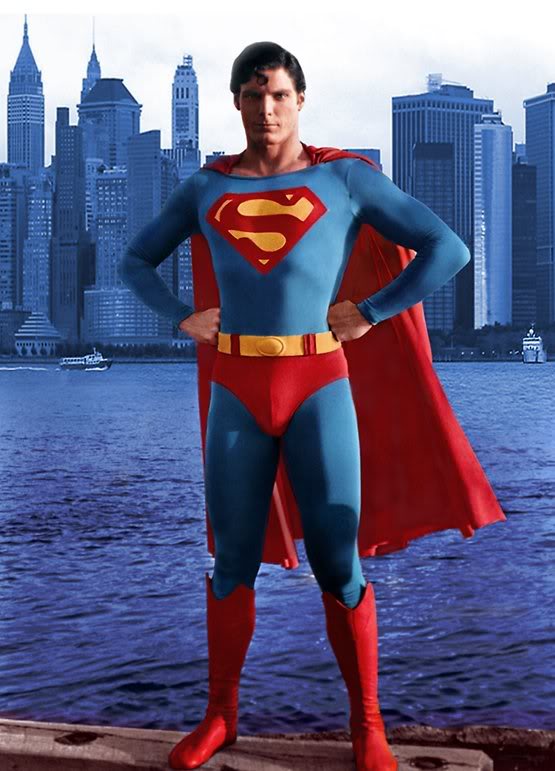
Can assuming the superhero stance make you feel and act that way, and alter your hormone production? That's what researchers Dana Carney, Amy Cuddy, and Andy Yap wanted to know. (Okay, they didn't examine the exact superhero stance exactly, but they did examine other two other open postures.) Here's what they did. Participants (male and female) were randomly assigned to pose in either two "high power" or two "low power" positions. The experimenter physically posed each participant in the poses.

High-power poses were sitting in a chair, arms behind the head, elbows out, and feet up on a desk (like a boss, "relaxing"), and standing in front of a table, legs about a foot apart, leaning forward and hands on the table bearing weight. Both these poses take up a lot of space for sitting and standing, respectively.
In contrast, the two low-power poses had those participants taking up little space; in the sitting version, the participants sat straight up, feet on the floor, legs at a 90-degree angle and hands on the lap while elbows were in, touching the sides. The low-power standing pose had participants put their legs close together and their arms were placed as if they were giving themselves a hug. Participants in all groups held each pose for one minute.

Low-power poses
Afterward participants moved on to a gambling task, in which they were each given $2, and then had the option of either not gambling (keeping the money, no risk involved) or a risky opportunity to roll a die and either double their money or lose the $2; they were told that the odds were 50/50. What's the purpose of this part of the study? To see whether assuming either a high-power or low-power pose led participants to behave accordingly-to be more willing to assume risk (high power, with the theory that if you're powerful you're more willing to assume risk), or play it safe (low power). Participants were also asked to rate how powerful they felt, on a scale from 1 (not at all) to 4 (a lot).
The researchers also took saliva samples at the start of the study (for the baseline) and 17 minutes after the last pose; through saliva they could measure a hormone associated with power (testosterone) and a hormone associated with stress (cortisol). Why testosterone and cortisol? Previous research on testosterone and power indicates that the testosterone level increases when a person anticipates competing as well as after winning, but the testosterone level drops when the individual loses e.g., Booth, Shelley, Mazur, Tharp, & Kittok,1989),. In other words, testosterone goes up with the possibility of or with actual power, and decreases when power-or the opportunity to attain power-is lost.
Cortisol is sometimes referred to as a "stress hormone" because levels of it often rise with stress; people who are powerful tend to have lower baseline levels of cortisol and when stressed, their cortisol levels don't rise as much as to people who are relatively powerless (Abbott et al., 2003; Coe, Mendoza, & Levine, 1979; Sapolsky, Alberts, & Altmann, 1997).. Chronically high levels of cortisol are associated with various stress-related illness such as high blood pressure (Sapolsky et al., 1997;), and these illness are more common in social groups that have low power than in those who have high power (Cohen et al., 2006).
Based on past findings about testosterone and cortisol, the researchers wanted to see whether assuming a pose for such a short amount of time would lead the brain to shift hormonal gears and create the typical high-power or low-power hormonal pattern. The answer was "yes." Participants who assumed high-power poses had their testosterone levels increase relative to their baseline, whereas participants who assumed low-power poses had their testosterone levels drop. The flipside was true of cortisol levels.
More importantly, the researchers wanted to know whether posing in high- or low-power positions would lead them to adopt the behavioral pattern typical of the power level associated with their pose. This answer, too, was "yes": Whereas 60% of low-power posers chose to risk gambling their $2, 86% of high-power posers risked their $2. (When reading about these results, I couldn't help but think of folks who work in the financial sector who no doubt regularly assume high-power poses as they jockey for promotions, for recognition, or to make a good impression [e.g., "I am powerful]. Perhaps assuming that pose leads them willing to risk too much? Perhaps the culture should encourage a more of a closed position, or at least something in the middle?) High-power posers also reported feeling more powerful than low-power posers, with an average rating of 2.57 versus 1.83, respectively.
So it seems that participants who assume a couple of superhero-type stances for a grand total of two minutes (!) feel more powerful and act that way. Wow. Stand like a superhero, feel like a superhero, act like superhero. Does this mean that when Clark Kent hunches and tries to make himself look unpowerful, his testosterone levels low and cortisol levels high? Does he take fewer risks as Clark than when he's standing tall in his boots and cape? Does he feel less powerful? If he's like us, the answer appears to be "yes."
(There is a wonderful scene in the first Superman film, by Richard Donner, in which Clark Kent and Lois Lane are about to go out and grab dinner; Clark is in Lois Lane's apartment waiting for her to get a sweater and as Superman he has just finished being interviewed by Lois and flown her around Metropolis. She is star-struck. As Clark waits for Lois, he's hunching over, trying to appear timid and unpowerful. He has a moment when he decides to tell Lois his real identity; he stands up tall, takes his glasses off and changes the tilt of his head. His body fully assumes a position of power and it is a pleasure to watch this embodiment of power as he allows himself to take up more space. Christopher Reeve did a fantastic job in that scene.)
References:
Abbott D.H., Keverne E.B., Bercovitch F.B., Shively C.A., Mendoza S.P., Saltzman W., et al. (2003). Are subordinates always stressed? A comparative analysis of rank differences in cortisol levels among primates. Hormones and Behavior, 43, 67-82.
Booth A., Shelley G., Mazur A., Tharp G., Kittok R. (1989). Testosterone and winning and losing in human competition. Hormones and Behavior, 23, 556-571.
Carney D.R., Cuddy, A. J. C., Yap, A. J. (2010). Power Posing: Brief Nonverbal Displays Affect Neuroendocrine Levels and Risk Tolerance.Psychological Science, 21, 1363-1368.
Carney D.R., Hall J.A., Smith LeBeau L. (2005). Beliefs about the nonverbal expression of social power. Journal of Nonverbal Behavior, 29, 105-123.
Coe C.L., Mendoza S.P., Levine S. (1979). Social status constrains the stress response in the squirrel monkey. Physiology & Behavior, 23, 633-638.
Cohen S., Schwartz J.E., Epel E., Kirschbaum C., Sidney S., Seeman T. (2006). Socioeconomic status, race, and diurnal cortisol decline in the Coronary Artery Risk Development in Young Adults (CARDIA) study.Psychosomatic Medicine, 68, 41-50.
de Waal F. (1998). Chimpanzee politics: Power and sex among apes. Baltimore, MD: Johns Hopkins University Press.
Hall J.A., Coats E.J., Smith LeBeau L. (2005). Nonverbal behavior and the vertical dimension of social relations: A meta-analysis. Psychological Bulletin, 131, 898-924.
Sapolsky R.M., Alberts S.C., Altmann J. (1997). Hypercortisolism associated with social subordinance or social isolation among wild baboons. Archives of General Psychiatry, 54, 1137-1143.
Copyright 2011 by Robin S. Rosenberg. All rights reserved. Robin S. Rosenberg is a clinical psychologist. Her website is DrRobinRosenberg.com and she also blogs on Huffington Post.
Monday, July 11, 2011
San Diego Comic Convention 2011

Saturday, July 23
1:00-2:00 Comics Arts Conference Session #11: Psychology of the Dark Knight: How Trauma Formed the Batman and Why He's Got a Thing for "Bad Girls"— How realistic is it that a young Bruce Wayne would vow to spend the rest of his life avenging his parents' murders and "warring on all criminals"? How did these seminal events shape the man Wayne becomes? And why is he attracted to "bad girls"? For answers to these and other questions, psychologists Travis Langley (Henderson State University) and Robin Rosenberg (Psychology of Superheroes) ask Batman writer Grant Morrison, one-time Catwoman Lee Meriwether (Batman: The Movie), journalist Jill Pantozzi (Newsarama), and executive producer Michael Uslan (The Dark Knight Rises). Room 26AB
Tags: Comic-Con Special Guest Spotlights & Appearances | Comics | Comics Arts Conference | Superheroes
Sunday, July 24
4:00-5:00 The Superhero Battlefield— What drives superheroes to keep fighting the good fight without getting burned out, disillusioned, or transforming into villains themselves? Trauma psychologist Dr. Andrea Letamendi (UCLA) explores the minds of your favorite comic book heroes and villains, linking them with the very real minds of actual trauma survivors. Alongside Dr. Letamendi are fellow psychologists Dr. Robin Rosenberg (The Psychology of Superheroes) and Dr. Travis Langley (Batman in his Belfry), as well as guest panelists including writer Len Wein (Swamp Thing). Room 4
Sunday, March 27, 2011
WonderCon 2001

About Did you ever wonder why experiencing trauma led Batman to become a hero but Harvey Dent to become a villain? Why Superman hasn't given up his Herculean task for good after being exposed to so much loss, stress, and destruction? What makes superheroes keep fighting without getting burnt out, disillusioned, or becoming villains? Join psychologists Andrea Letamendi (UC San Diego) and Robin Rosenberg (Psychology of Superheroes), psychology professor Travis Langley (Henderson State University), and WonderCon special guest Marv Wolfman as they address these questions, applying what we know about trauma in our world to the world of superheroes to better understand why the same types of events can lead some folks to heroism and others to villainy.
Hope to see you there!
Wednesday, September 1, 2010
On Mental Toughness
 Superheroes, or most any kind of persistent heroes, have to be tough in order to keep doing what they do, day after day. Lately, I've been reading about mental toughness, a term psychologists use to characterize a quality studied in athletes (particularly elite athletes of various types; Crust, 2008; Nicholls et al., 2009). Mental toughness has four components:
- Control: a sense of control of yourself and what happens to you; that is, a sense of being able to shape your destiny rather than passively accepting events as fated.
- Commitment: a strong sense of being committed to yourself and your work. That is, being fully involved in something, giving it your best shot.
- Challenge: a tendency to see life's downs and obstacles and challenges to be met rather than as threats.
- Confidence: A belief in yourself and your ability to meet your goals.
According to Peter Clough, a leading researcher on mental toughness,
Mentally tough individuals tend to be sociable and outgoing; as they are able to remain calm and relaxed, they are competitive in many situations and have lower anxiety levels than others. With a high sense of self-belief and an unshakeable faith that they control their own destiny, these individuals can remain relatively unaffected by competition or adversity (Clough et al., 2001, p. 38).
When I read this quote, I thought of superheroes (or action heroes like James Bond).
Although certain situations may elicit mental toughness more than other situations, research indicates that some people are generally more mentally tough than others (that's why it's considered a personality trait) and it arises from both genes and environment (particularly adversity). For athletes, such adversity includes an exposure to a tough sport environment (challenging competition) and early setbacks through which the person can learn from failure (Bull et al., 2005).
Reading about mental toughness led me to reflect (again) on the perceptiveness of superhero comic book writers--who probably derived the idea of mental toughness from observing the real world. The writers provided many superheroes with both the components related to mental toughness, and the environmental adversity to toughen up the heroes. For instance, pre-spider bite high school student Peter Parker (who becomes Spider-Man after being bitten by a radioactive spider) http://marvel.com/universe/Spider-Man_(Peter_Parker) is characterized as someone who has the elements of mental toughness:
- Control: Peter certainly tries appears to have a sense of control; he tries to make things happens socially, and he exerts effort and his school, undoubtedly because he believes that the effort will make a difference.
- Commitment: He marches to his own drummer, partaking activities that he enjoys rather than simply going along with the group if he doesn't like the activity.
- Challenge: He enjoys challenging himself: He created the web fluid and web shooters (the fluid dispenser) just for fun, to challenge himself.
- Confidence: He has confidence in his intellectual abilities and, on some level, has social confidence because he asks his classmate Sally and invites his classmates to the Science Hall exhibit (in the very first Spider-Man story, by Stan Lee and Steve Ditko; see Amazing Fantasy #15). Moreover, once he has his powers, he decides to join the Fantastic Four-and he assumes that they'd want him.
 And like many people with mental toughness, Peter has experienced adversity (Dienstbeirm 1989): (1) his parents died when he was young, (2) his aunt and uncle-his guardians--have limited financial means, and (3) Peter is socially marginalized, despite his best efforts. And of course Peter's guilt about his unintentional role in the death of his beloved Uncle Ben toughen Peter up.
Spider-Man is only one example, but mental toughness runs rampant in the superhero world: I'm thinking of Batman, Green Lantern, Wonder Woman, Buffy the Vampire Slayer. The list goes on.
Since most of the research on mental toughness, though, I got to thinking. Is this personality trait (and it's similarity to qualities possessed by superheroes/heroes) the reason that great sports figures are considered heroes? Perhaps the term hero has become almost synonymous with the qualities of mental toughness.
Copyright 2010 by Robin S. Rosenberg. All rights reserved.
Robin S. Rosenberg is a clinical psychologist. Her website is DrRobinRosenberg.com. Click here to take her brief What is a Superhero? Survey.
Sunday, August 8, 2010
Comic-Con: Nerd and Geek Community
 Imagine that you are a basketball fan in a community that wasn't generally into basketball (or, more realistically, imagine having been a soccer fan 20 years ago). You watched the game on TV last night and want to talk about it with someone who "gets" it. People at work don't understand your passion and you've learned to be quiet about it with them. The only people you can share with are online, but it's not quite the same. Now imagine yourself going to a basketball game: everyone is there because they enjoy basketball. Although the fans may be divided by their team loyalties (so there are two groups of fans), it's the one place where you can enjoy the physical company of others who enjoy the sport as much as you do.
That's what it was like for people at the San Diego Comic Convention a couple of weeks ago. There were at least 150,000 people there, and the convention center was swarming with attendees, a good number of whom were in costume. I interviewed some attendees, asking them why the came to the convention. Most folks I talked to cited the sense of community as a reason they came to the convention; that is, they wanted to be with other like-minded folks.
I was struck by the power of community--a power that brought attendees from far and wide. An ethnically diverse community (and almost equal numbers of men and women) composed of families, couples, singles, and groups of friends. The folks at the convention may use the Internet to create their own virtual communities of like-minded "friends" (I use the term friends loosely, in much the same way as Facebook does). But there is something about stepping into a convention center, an exhibit hall, and a hotel, knowing that you share an interest with almost everyone there. It's similar to feeling that some people get when they attend a sports event-except in that case there are two communities in the same location, one for each team. At the convention, though, there were no "teams" in competition with each other. Sure, there were different groups: the artists; the comic fans, eager to meet the writers and artists of their favorite strips; the gamers; the popular culture crowd-relative newcomers, there for the previews and panels about upcoming films and TV shows. The different factions accepted each other as part of a big, generally happy, family.
Research tells us that social connections are important: they buffer us from stress, boost our immune system, give us a sense of belonging, motivate us, bring us joy, and make us feel liked and loved. (Of course some social connections can have the opposite effect-they can cause us stress, lead us to be immune compromised, and leave us feeling dejected; but I'm not talking about that now.)
A large portion of the attendees at the convention--or any comic convention--are likely to be some form of nerds or geeks. (What's the difference between a nerd and geek? That depends on where you live and when you were born, but you can click here for an overview on the distinction.) Depending on where they grew up and went to school, people who are nerds or geeks may socially have had a hard time--they may have been victims of bullying or social ostracism--or had a perfectly fine time with a group a like-minded friends.
The stereotype of nerds and geeks are that they are socially obtuse folks with Asperger's; that is, they aren't socially aware and don't know how to be socially appropriate. Not so fast. It isn't necessarily that nerds or geeks don't get how to be "cool." Rather, at least some of them reject the trappings of cool. They intentionally eschew the noticeable markers of cool (certain styles of clothes, topics of conversation, ways of speaking) (click here for The Whiteness of Nerds by Mary Bucholtz, 2000.) They cultivate an identity and appearance of being different. As psychologist Mel Levine notes
"There are a lot of depressed cool kids, and it's better to be a happy nerd than a popular anorexic...Nerdiness isn't a pathology."
When lucky, there are enough nerds in school or neighborhood to form a community of like-minded folks.
It's that community aspect that's so visible at Comic-con and similar conventions. There is the sense of being among one's people. It isn't necessarily that nerds and geeks can't be social; instead, their social interactions don't conform to the traditional ones.
"Nerd subcultures like the ones surrounding comic books and science fiction can be safe places for nerds to learn to make friends outside the brutal social hierarchies of school and the office. (Comic-Con, the largest annual nerd gathering, draws 175,000 fans of Gandalf and Wonder Woman to San Diego every summer)." (Nugent, 2007; click here for the post the quote is taken from.)
Before the Internet, only the lucky few nerds and geeks had a critical mass similar people to develop a sense of community. With the rise of the Internet, geeks were among the first to create a vibrant virtual community-they led the way. Consider these quotes from an article by ANthony Faiola in the Washington Post:
"The Internet has taken its power one step further. It is transforming them from an alienated and virtual community into a thriving, real-world fraternity -- and, to a lesser extent, a sorority -- whose members are physically interacting as never before at concerts, comedy clubs, even ‘nerd expos'."
"A lot of people are coming out of their geek closet and proclaiming themselves a nerd, and they are joining together in doing it," said David Glanzer, Comic-Con marketing director.
It is at conventions such as this one that nerds and geeks can have the experience that sports fans routinely have when, the morning after a game, they chat about the game with fellow commuters or people at work and expect that other people will know about the game and feel similarly. To community!
Copyright 2010 by Robin S. Rosenberg. All rights reserved. Robin S. Rosenberg is a clinical psychologist. Her website is DrRobinRosenberg.com. Click here to take her brief What is a Superhero? Survey.
Monday, July 12, 2010
San Diego Comic Convention 2010
If you're going to be at the San Diego Comic Convention on Saturday, July 24, stop by for this panel:
10:30-11:30 am Comics Arts Conference Session #9: Batman and the Empty Nest Syndrome — Does Batman become a different type of person when he has a sidekick? Join panelists Denny O’Neil (Batman writer and editor), Michael Uslan (Executive Producer, Batman Films), psychologists Travis Langley (Henderson State University) and Robin Rosenberg (The Psychology of Superheroes), Tommy Cash (The Workday Comic), and neuroscientist E. Paul Zehr (Becoming Batman) as they discuss who Batman is when he works alone versus who he becomes when he works with Bat-family members. Room 26AB
I hope to see you there!
Wednesday, July 7, 2010
Wonder Woman as Émigré

I read last week that DC Comics will be reimagining (sort of) Wonder Woman's origin story (and costume). For those of you unfamiliar with Wonder Woman's (Diana's) origin--the origin before this new one--here are the aspects of her story that germane to the rest of this blog post:
- Wonder Woman is an Amazon--a nation of strong women (and only women)--who live sequestered on Paradise Island; on this island there is food aplenty, no war, and the women living there are immortal while on the island. Although Diana knew that men exist, she had never met one.
- Diana wanted to leave Paradise Island in order to accompany to the United States a wounded solder whose plane crashed off Paradise Island (he couldn't stay on the island because it is for women only, and he wasn't able to return on his own. He was the first man Diana had ever seen.) Diana's mother, the Amazon's Queen, forbade Diana to leave Paradise Island.
- The Queen decides to hold a tournament to determine who is the strongest, most able Amazon; the winner will take the soldier to the United States.
- Diana disobeys her mother and enters the tournament, wearing a mask to disguise her identity; she wins the tournament, knowing that as the winner she must be prepared to leave Paradise Island forever.
My point here is that Diana is very motivated to leave, despite her apparently idyllic existence on Paradise Island. (For those interested in finding out more about Wonder Woman's history, I recommend that you click here and here.)
The new reimaging will change all that, which could be interesting because part of Wonder Woman's personality is reflected in her desire to emigrate. The classic origin story of Wonder Woman is the tale of a young woman desperate to emigrate to a new land--filled with men and different ways and customs. In fact, she so much wants to emigrate that she's prepared both to leave behind forever everyone she's love as well as to lose the Amazonian advantages of perfect health and immortality. Why might someone risk so much to emigrate?
Some people emigrate because their life in their native land is harsh: war, famine, oppression, poverty, or discrimination-with little possibility of significant improvement if they remain. In such cases, the specifics of the situation motivate people to leave who might otherwise remain in their native country in better circumstances. That's certainly not the case with the Princess.
The Princess's desire to move to America reflects constellations of personality traits--personality dimensions--that are typical of many people in our world who emigrate (Olson, 2007):
- Extraversion: composed of enthusiasm, adventurousness, optimism, and a tendency to seek our excitement, thrills, and risk;
- Openness to experience: composed of curiosity and a preference for variety and novelty.
People high in these personality dimensions are more likely to get bored in a culture that is closed and monotonous--like that of an island culture, particularly one in which there is not a lot of back and forth with other villages and other people (like Paradise Island). People who score high in extraversion are more likely to emigrate than people who score low on these dimensions (Chen et al., 1999). In contrast, people low on both of these dimensions will be more content--or at least more willing--to stay home, both literally in their home as well as culturally at home, not venturing into cultures too different than their own.
It's easy to imagine someone like Diana, someone who's bored with the monotony of village life--especially life in a village life in which food is plenty, health is guaranteed, and most tasks are easy for her. She must have been itching to leave. (And it's likely that Amazons who were similarly high in extraversion and openness to experience left Paradise Island long ago; the women left on the island are those who aren't likely to have much wanderlust (Olson, 2007).
In fact, research bears out this speculation about Diana's wanderlust and that of past Amazons. Italian psychologists Camperio Ciani and colleagues (2007) compared the personality traits among residents of three small island Italian villages with villagers from three mainland areas facing the islands. Each of the small islands in the Tyrrhenian Sea has a history of isolation; people do not frequently move between islands, or from the mainland to an island. (Researchers estimated that in every generation, around 30% islanders would have to leave because given the space limitations of each island, only a fixed number of residents could be sustained.) In fact, until recently, the islands were relatively isolated from the mainland.
As part of the study, the villagers completed questionnaires and also were interviewed. Consistent with the personality traits of people who emigrate, all three sets of islanders (each of whose grandparents were also islanders) were less extraverted and less open to new experiences than were the mainlanders. That is, people who were temperamentally suited to island life left so that those who remained did not have the personality traits characteristic of wanderlust. Those who were most willing to emigrate to other parts of Italy did so. And people born on the islands but then emigrated to the mainland had higher levels of extraversion and openness to experience than did people born on the islands but who remained. These personality dimensions have a genetic component (Angleitner & Ostendorf, 2000), and so the children of those who remain on the island are in turn more likely to feel comfortable with life on an isolated island. As the researchers note:
"In effect, extraverted individuals like novelty-seekers (Benjamin et al., 1996) are expected to be more emigration-prone, since they have a more outgoing attitude and are more curious about new environments; thus, their alleles fade away, since they leave no descendants on the island. Islanders also become less open to experience, due to the fact that life on small islands is more repetitive than on the mainland, and individuals with high levels of openness find less cultural, social or intellectual stimulation in such confined spaces. All these factors may induce extraverted and open individuals to leave the island." (p. 14).
Other studies found similar results. One study found that Finnish people high in extraversion were more likely to move from their native rural area to a more urban area--and were more likely to move longer distances--than their low extraversion counterparts. And in the United States, people high in extraversion and openness were more likely to move within a given period of time than were people lower in these personality dimensions (Jokela, 2008; Jokela et al., 2009).
Changing the emigration aspect of Wonder Women's origin changes who she is; I guess that's part of the plan.
Copyright 2010 by Robin S. Rosenberg. All rights reserved. Robin S. Rosenberg is a clinical psychologist. Her website is DrRobinRosenberg.com. Click here to take her brief What is a Superhero? Survey.
References:
Angleitner, A., & Ostendorf, F. (2000, July). The FFM: A comparison of German speaking countries (Austria, former East and West Germany, and Switzerland). In J. Allik (Chair), Personality and culture: The five-factor theory perspective. Symposium conducted at the 27th International Congress of Psychology, Stockholm, Sweden.
Chen, C., Burton, M., Greenberger, E., & Dmitrieva, J. (1999). Population migration and the variation of dopamine D4 receptor (D4DR) allele frequencies around the globe. Evolution and Human Behaviour, 20, 309-324.
Ciani, A. S. C., Capiluppi, C., Veronese, A., & Sartori, G. (2007). The adaptive value of personality differences revealed by small island population dynamics. European Journal of Personality, 21(1), 3-22.
Olson, K. R. (2007). Why do geographic differences exist in the worldwide distribution of extraversion and openness to experience? The history of human emigration as an explanation. Individual Differences Research, 5(4), 275-288.
Sunday, May 9, 2010
Iron Man 2: A-Rusted Development?

Like many people, I saw Iron Man 2 this past weekend. Below is a brief general review of the film, followed by a discussion of a couple of psychological issues that stuck in my mind after I saw the film. But first I have to make a confession: I really liked the first Iron Man film. I thought it was a brilliant, modern reboot of the character, something much more powerful than the original comic book Iron Man origin story. As a psychologist, I thought it did a lovely job of conveying some of the changes the trauma survivors undergo when they come out of the other side of their experience-specifically that they may develop a new philosophy about the meaning of life and their sense of purpose (this area of psychology is referred to as posttraumatic growth or stress-induced growth). I had high hopes for the sequel.
Okay, here's my general review (with minor spoilers): I thought that the film introduced too many new significant characters for its two-hour running time. The glut of new characters (plus the old ones) meant that all characters were portrayed as cartoons. (Yes, I understand the irony of my statement-the characters are based on comic book stories. BUT what was so neat about the first film was that it didn't feel as if it was based on a comic book. The characters-particularly Tony Stark-felt real.) There were so many new significant characters that each could only receive superficial treatment-we learn only just enough about the character to move the plot along to the next scene. If the film had been an hour longer, this would not have been a problem. (Pet peeve: The film version of Justin Hammer shares little with his comic book character beyond name and job title; the film's version is a buffoon and it's hard to see how he could attain and maintain the position of head of a large weapons manufacturing company. He was simply too two-dimensional.)
By analogy, this film reminded me of comic book stories from the 1960s and 1970s-fast paced, plenty of action, only enough exposition to advance the plot. In contrast, the first Iron Man movie reminded me of more recent comic book stories-the characters had more psychological depth, more angst, and their internal conflicts and struggles were relatively clear.
Just as The Empire Strikes Back (Star Wars, Episode V) clearly was a vehicle to bring the viewer from Episode IV to Episode VI, part of the goal of Iron Man 2 seems to have been to bring viewers from the first Iron Man film to the upcoming Avengers film. I would have enjoyed seeing what director Jon Favreau could have done with this sequel if the story had been relieved of the burden of creating a bridge to the Avengers film. Still, Iron Man 2 was a good romp.
On to my "psychological" review of the film. While watching the film, two aspects stood out for me. [spoiler alert: if you haven't seen the film and don't want to know too much about the film, skip down a couple of paragraphs] One was Stark's episode of binge drinking (his drinking is likely to play an even bigger role in subsequent films if they model themselves after the Demon in a Bottle storyline by Doug Michelinie and Bob Layton). We can see that Stark is struggling with mortality issues (as he did in the first movie-only in that film it was about his heart and the threat of being killed by his captors). In Iron Man 2, he's confronting the possibility of his death through poisoning: The Palladium that powers his chest magnet is becoming toxic to his system. He keeps this bit of information to himself, and deals with it by drinking himself silly on his birthday, assuming it will be the last birthday he has. He did this drinking while wearing his Iron Man armor.
Tony's drinking got to the point where his blood alcohol level probably reached around 0.20 (plus or minus 0.05). As you can see in the table below, this is a frightening level for anyone to reach, let alone someone in Iron Man armor. Favreau and his crew did a nice job of conveying how impossible it is to reason with someone who's this far gone. Tony becomes irrational and-most importantly-incredibly irresponsible, putting his guests' lives at risk. He staggers, his motor functions are impaired, he doesn't understand what going on. The only way to "contain" him was for his buddy Rhodey to don some armor and try to corral Stark. Stark bucked like a drunk bronco. And even though Rhodey hadn't previously logged many hours in the armor, his inexperience was compensated for by the physical and mental effects of Tony's drunken state.

(Source for chart: click here.) [end of spoiler alert]
The other theme that I want to touch on here was Stark's age-or more accurately, Robert Downey Jr.'s age. Don't get me wrong-it's refreshing to see a middle aged actor playing a superhero. But in an early scene I noticed his age. So it got me thinking that of all superheroes to be portrayed by someone in middle age, Iron Man is the best possible choice. Here's why. As people get older:
- they typically lose muscle strength, but when wearing Iron Man armor, this muscle strength loss is irrelevant. Score one for an aging Stark.
- their speed of responding typically declines-they take a bit longer than they used to. Unfortunately, this would probably affect Iron Man's performance in some situations-those in which fast reflexes are essential. Stark loses a point on this one.
- they may develop increasing difficulty hearing high-frequency sounds, such as distinguishing certain words that differ by a single consonant-like kill and pill. This could be a problem for an Iron Man down the road.
- have a harder time multi-tasking, specifically with tasks that require the person to hold information in mind while also doing something else. This is a type of mental juggling that Iron Man must do frequently.
Now for some good news for an aging Iron Man: Even though middle-aged or older adults may experience these physical and mental changes, many of the changes are offset by the wisdom that comes with years and experience. For instance, older adults compensate for their slower reaction time by having better (e.g., more efficient or logical) strategies than their younger counterparts. Some other good news: as people get older, they become better at regulating their emotions (click here and here for articles on this topic). This would definitely be a plus for Stark, who can go off half-cocked and be too emotionally reactive.

Copyright 2010 by Robin S. Rosenberg. All rights reserved.
Monday, April 26, 2010
Is the Joker a Psychopath? You Decide!
Thanks to Mike Catron, comics historian and videographer, you can watch the San Diego Comic-Con 2009 panel, Is the Joker a Psychopath? You Decide!
Panelists include (in alphabetical order):
- Steve Englehart (comic book writer ; by phone)
- Travis Langley (psychologist)
- Jerry Robinson (Joker co-creator)
- Robin Rosenberg (psychologist)
- Michael Uslan (executive producer, Batman films)
- Adam West (actor, 1960s Batman TV show)
Monday, April 12, 2010
Superhero Origin Stories
If you're interested in superhero origin stories, you can hear highlights of the panel, "It All Began When...: Making Meaning of Superhero Origin Stories" with Steve Englehart, James Robinson, and me at WonderCon 2010.
Part one is below, and the other two parts can be accessed at my new YouTube channel, Psychablog.
Sunday, March 28, 2010
Psychology Today: The Superheroes Blog

Have a good week, and I'll post about WonderCon next week.
Wednesday, March 10, 2010
April Is a Busy Superhero Month--Comic Conventions
April will be a busy Superhero month. In case you’re planning to attend either WonderCon in San Franscico or C2E2 in Chicago (Chicago Comic and Entertainment Expo) stop by at these panels:

Panel: It All Began When…: Making Meaning of Superhero Origin Stories
Psychologist Robin Rosenberg (Psychology of Superheroes) and comic book writers Steve Englehart (DC, Marvel, Max August) and James Robinson (DC, Marvel) discuss why the origin story is important, ways that the origin story hems in a character, and why and how the origin story is tweaked (or rebooted) by subsequent writers. We’ll also discuss how both fans and writers make meaning of a superhero origin story.
At C2E2—Chicago Comic and Entertainment Expo:

Panel #1: Are Supervillains Evil? Understanding Evil in the Superhero World; Friday, April 16, 4:15 P.M.
Psychologists Robin Rosenberg (Psychology of Superheroes) and Mikhail Lyubansky (University of Illinois), and attorney Amy Martin explore the nature of evil and how different supervillains’ life experiences and personal characteristics indicate various pathways to criminal behavior. The panel will also explore the implications that these various paths have for our notions of justice-- and therefore--how we think about the actions of the superheroes who fight the villains.
Panel #2: Forging Iron Man: The Psychological Construction of Iron Man's Origin Story; Saturday, April 17, 12:15 P.M.
Psychologist Robin Rosenberg (Psychology of Superheroes) and others examine Iron Man's various origin stories and reveal what they tell us about Tony Stark and his decision to become Iron Man.
Subscribe to:
Posts (Atom)
